
To set the scene for our “Old Christmas Carols” performance and today’s Creole Christmas garden party, the owner of Magnolia Mound in the early 1800’s was a Frenchman, Armand Allard Duplantier, a former captain in the Continental Army under Marquis de Lafayette. Duplantier was a French aristocrat, born and raised in France and he first served in the calvary of that country. Then he became a personal aide to General Lafayette serving in the Revolutionary War under Lafayette. After this war, Duplantier came to Louisiana. He married an Irish widower, Constance Rochon Joyce, and the couple settled on Magnolia Mound. They enlarged the original cottage to accomodate their large family and furnished it with the best imported French furniture by way of the port of New Orleans. It was a fine antebellum plantation home.
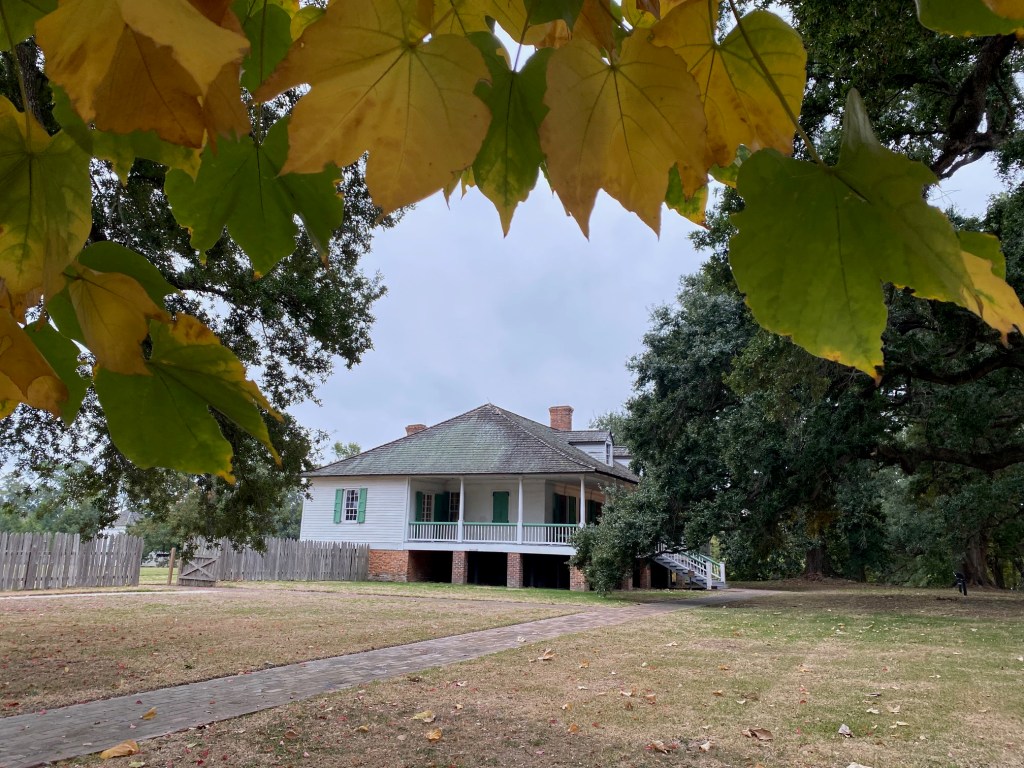
The 900-acre plantation was run by an overseer. Cotton, sugarcane, tobacco and indigo were grown in the fields. The crops were grown and harvested by hand. Many people lived on the plantation and labored in the fields to produce the crops.
Christmas was celebrated quite differently in colonial days back in the late 1700’s and early 1800s. It was a smaller, family affair, perhaps with a fancy meal — no commercialism. French Catholic families attended Mass on Christmas Eve, followed by a meal of gumbo and then dancing and singing all night. It wasn’t until the mid 1830’s that Christmas Day was even declared a state holiday. Slaves then got the day off from work. Sometimes the holiday was extended the entire week to New Years Day.
Our “Old Christmas Carols” program includes carols from France, England and Germany. It includes very old carols that Duplantier may have known when he grew up in France in the 1700s. Often these songs centered around the nativity or birth of Christ. To encourage the parishioners to come to church, the priests held “mystery pagents” or “plays” depicting the birth of the baby Jesus. The townspeople would walk and sing through the town, coming to a nativity scene which was set up outside the town cathedral. The story of the birth of the Christ child was then enacted including the mother Mary, Joseph, baby Jesus, shepherds and wise men. The priests were allowed to sing and dance as long as they kept both feet on the ground.
Although there are not many known Aftrican-American spirituals dating from this time period related to Christmas, we are including one which originated on a Louisiana plantation in the late 1800’s. The lyrics for “Rise Up, Shepherd, and Follow” are found in a novel called a “Christmas Story” about a fictional plantation somewhere in Louisiana. Later, the melody was added. It is a beautiful, soulful song.
Carols date back to the middle ages and can be written in praise of any important event of the year — May Day carols, for example. Carols were often written to celebrate the fall harvest which occured around the winter solice and Christmas time. There was dancing and singing and often parading through the town..Eventually, these carols became associated with Christmas and became what we know as Christmas carolling. “We Wish You a Merry Christmas” is one of these carols and presumedly came from South-West England in the 16th century. The lyics state that the carolers won’t stop singing until the homeowner brings them some Figgy Pudding.
In England, wassailers were carolling groups who went around the town and were rewarded with a hot, spiced drink, known as ‘wassail’. The word ‘wassail’ was a toast and comes from the Old Norse ‘ves heill’ meaning ‘be well and in good health. Often the wassail was mulled spiked apple punch served in a wooden bowl, in celebration of the apple harvest and blessing for a good crop in the coming year. “Glouchesershire Wassail” is one of these tunes.
Germany and Austria have provided us with many lovely Christmas Carols. “Still, Still, Still” is an old, old lullabye celebrating the birth of Christ and comes from Germany.
Reference:
 Louisiana Dulcimer Gumbo